Showing posts with label 1933. Show all posts

Friday, March 15, 2013

KING KONG goes "beyond the realms of practical adventure," 1933 interview with Merian C. Cooper

"News And Gossip From Hollywood;
Where Apes Grow 40 Feet Tall"

The Loredo Times, Feb. 5, 1933


By DAN THOMAS
NEA Service Writer

HOLLYWOOD, Feb. Dreams seldom become realities — but they often become motion pictures.

There are, for instance, the absurdities of a Marx brothers' film; the almost inescapable happy endings of romances.

Then there are such films as "Just Imagine," made a couple of years ago, based on nothing but a rampant
imagination. In this category, we are about to be handed "King Kong," purely a dream picture if there ever was one. "King Kong" is the result of the dream of an adventurer now so shackled to his desk that his haz­ardous expeditions can take place only in his mind.

For years Merian C. Cooper wan­dered over the globe in search of adventure Many of his roamings have brought him financial rewards with such pictures as "Grass" and "Chang," which he made in con­junction with Ernest B. Schoedsack. Now Cooper is a film executive and an official in four of the nation's big air lines as well. Hence, his wan­derings are confined pretty much within the four walls of his office.

But, that doesn't stop him from dreaming—although now he must dream of tilings which will return a profit. Naturally his mind turns to, travel and adventure. But, there isn't much left in those fields for new screen entertainment. So he had to go further.

"I decided to go beyond the realms of practical adventure," Cooper told me. "I conceived a story basis which at one time or another challenges the imaginations of all adventurers. We who have seen the last remnants of a prehistoric age often have won­dered what would happen if some  thunderous reversal of nature made possible the rebirth of ancient ani­mals.

"Of course, this couldn't, happen. But isn't it an intriguing idea? At least, it's out of the ordinary run of things. And after all, moton pic­tures must possess novelty if they are to be interesting."

And so a year ago the idea for "King Kong," the most novel and imaginative of all films, was born. It has been under production six months. The picture is based on the supposition that somewhere there is an island inhabited by prehistoric animals.

One of them, a huge 40-foot ape, is brought, to New York for exhibition purposes. Crazed by the sight of a fragile, white-skinned woman, he breaks loose and runs amuck on crowded Broadway in search of her. He finds her and carries her to the top of the. Empire State Building. There he makes his last stand against a squadron of army pursuit planes which finally kill him.

Sunday, January 27, 2013

The Testament of Dr. Mabuse (1933)


Fritz Lang's THE TESTAMENT OF DOCTOR MABUSE is a confounding film. It's thoroughly satisfying, even though its resolution resolves nothing. It provides the thrills and chills found in pulp fiction of the era, though it lacks the formulaic story structure (and quaint moralizing) of those tales. It's a mystery, of sorts, that is never adequately explained, and it's an adventure without traditional protagonists. Though the movie has its share of heroic figures, none of them accomplish anything more profound than saving their own necks.

I have to wonder what Lang hoped to accomplish with this story. It's a fascinating bit of film that can be as subtle as it is heavy handed. Despite the care and planning that went into constructing every scene in the film, one of its best moments happens to be one of its shortest: Professor Baum, played by Hungarian actor Oscar Beregi Sr., walks past a wall that's been covered in posters soliciting information for unsolved murders. Are they the work of the crime cult organized by Doctor Mabuse? Is Baum really the man pulling the strings of the cult? And, if so, is he even aware of it? Baum doesn't even spare a glance at the pageantry of death as he walks by the posters, which makes the scene all the more chilling.

As the movie begins, it's been a decade since Doctor Mabuse was arrested following string of violent, bizarre crimes. A resident of an insane asylum, Mabuse has kept himself busy despite his catatonia. Even though his mind is gone, his hand continues to write. When a pen is placed in his hand, it scrawls plans for murder, robbery, arson and blackmail. Those plans gradually find their way to the outside world where a new "Reign of Crime" begins.

The trail to Mabuse leads to an endless series of curtains, cutouts and brick walls. Mabuse, who becomes the prime suspect in the crime, promptly dies, all while a handful of seemingly unrelated crimes continue to point in his direction. Mabuse (whose name is rarely spoken aloud by his many followers) is treated with the sort of reverence usually reserved for gods. Even his henchmen engage in almost-theological discussions about their employer and his mysterious methods. And those who try to prove his existence are met with frustrsation, if not death.


It's hard not to see the similarities between the crime cult's thug-like behavior and those of the Nazis, who were still consolidating their power in Germany when the film was produced. Both the criminals and the Nazis answered to shadowy figureheads who prized obedience more than innovation, and it's no coincidence that the film's heroes are the ones who think and speak for themselves. Even though Lang makes no direct reference to the political climate in late 1930's Germany, its subtext was enough to keep the film from being screened in his homeland until several decades after World War II. Even then, it was shown with an abbreviated running time.

This commentary is tarted up as the kind of pulpy potboiler you'd find in a BATMAN comicbook, only minus the caped crusader. The closest thing the movie has to romantic leads find themselves trapped in a room with a ticking timebomb (a room that is also filling with water.) There are phantom voices, madmen, explosions and so many interlocking conspiracies that you'd swear the script was the work of Mabuse, himself, as he scribbled away in his asylum cell.

On this level, THE TESTAMENT OF DOCTOR MABUSE functions like a well-oiled, well-edited movie serial. If that were all the movie had to offer it would probably be enough, but it was made by a man who understood his craft like few directors ever would. Lang was the kind of filmmaker the world wouldn't see again until Steven Spielberg, a director who could make crowdpleasers with both heart and substance. There are a few scattered moments of outright horror in the movie, such as the huge, alien eyes that make up most of Mabuse's ghostly face. Generally, though, Lang created a fantasy grounded in a warped version of reality. Comparisons to 2008's THE DARK KNIGHT are appropriate.


Even though THE TESTAMENT OF DOCTOR MABUSE doesn't share the Old Testament morality of the pulps, the movie has an alarmingly accusatory tone. At times it's a little like having a conversation with someone who doesn't understand personal boundaries.  Lang's insistence on having the actors look into the camera for many of the film's more dramatic sequences forces a very quiet form of audience participation. There were times I wondered if Lang was intentionally screwing with his audience. Even the opening sequence is largely silent as the sound of a printing press drowns out all dialogue as it cranks out reams of counterfeit money. Almost ten minutes pass before a single word of dialogue is spoken. More to the point, Mabuse, himself, doesn't speak at any point in the film. The film is a sequel to Lang's silent DOCTOR MABUSE THE GAMBLER, released ten years earlier, and it appears Lang intended to cast his villain as a relic of the past. But that doesn't mean the villain doesn't have a thing or two to still teach the future.

(NOTE: Director ANSEL FARAJ  is currently in post production on a new film about DOCTOR MABUSE. Listen to my interview with Faraj in THE COLLINSPORT HISTORICAL SOCIETY podcast.)

Thursday, July 19, 2012

King King is Coming, Part 3 (1933)


"King Kong" finds a deadly dinosaur threatening Ann, whom the ape deposits in the crotch of a high tree for safety while he does combat with the Tyrannosaurus,measuring nearly seventy-five feet from nose to tail. Afraid as she is of her fate in the hands of "King Kong" she still wants the great' ape to win.
The open mouth of the Tyrannosaurus is far more terrifying.


No sooner has "King Kong" dispatched the dinosaur than  another monster ages old — a water serpent— raises its long neck from a pool. Driscoll, Ann's lover, gamely trailing the ape, watches "King Kong" crush - this monster's head in his mighty grip. He wonders,' why "King Kong" has protected Ann instead of devouring her.


Home at last at the top of Skull Mountain, "King Kong" proceeds to inspect the wonders of the golden beauty that is now his. He is so fascinated as he tears off Ann's sheer garments that he does not note the
approach of a Pterodactyl, giant-winged reptile, until it has ravenously snatched Ann out of his paws.


Now the Beast has lost his Beauty! Driscoll, hiding in the darkness, watched his opportunity to steal Ann away. there is but one help for their safe escape and that is to drop thousands of feet into a lake.

Monday, July 16, 2012

King King is Coming, Part 2 (1933)

In 1933, RKO produced a six-part illustrated comicstrip that ran in newspapers across the country to promote KING KONG. This is the second installment. The captions are reproduced here as they originally ran.


What queer world is this? A fifty foot ape carrying off a white girl! And now the crew of the Adventurer hurrying to rescue Ann finds minster reptiles from prehistoric ages - monsters believed non-existent for millions of years! Bullets making no dent on the dinosaur's horned hide, they try gas bombs!


Another prehistoric reptile — the Brontosaurus, astounds Denham, Driscoll and members of the crew fighting their way through jungle - and swamps to rescue Ann. The monster overturns their raft, catches men betweeen its teeth and shakes them as a terrier shakes rats. Camera prcious gas bombs and lives are lost.


What chance has pjgmy against the huge, fantastic beasts of this nightmare "Skull' Island.'' An injured Triceratops on one bank. Great, hungry crawling things beneath. On the other bank "King Kong," shaking the trees until the men fall to a hideous death in a precipice, Driscoll and Denham, escaping to opposie cliffs, watch the tragedy helplessly


Unable to move from his narrow ledge on the cliff, Driscoll stabs furiously, at the great paw of "King Kong," who has discovered him. But his knife makes no more impression than the scratch of a pip on a man's hand. A scream from Ann draws "King Kong's" attention to a new enemy.

Saturday, July 14, 2012

Ape Vs. Tyrannosaurs in KING KONG (1932)


"King Kong Planned To Thrill Picture Audiences" 
The Laredo Times, May14, 1933

With a sensational mixture of the prehistoric and the modern in a story of fantastic imagination, RKO-Radio makes a bid for an all-time record with its spectacular production, "KING KONG," featuring Fay Wray, Robert Armstrong and Bruce Cabot and in the same role a great animated 10-foot-ape, built to a proportion comparable with monsters of the Jurassic and Cretaceous periods, "King Kong" will be presented at the Rialto Theater 3 days more.

As a production, "King Kong" was two and a half years in the making. Early in 1929 the first research inquiry was sent to leading paleontologists throughout the world. The studio had a vital interest in the appearance and habit of such primitive monsters as the pterodactyl, the brontosaurus, the tyrannosaurus and the dinosaur.

Did these formidable creatures, now extinct, run, hop, or fly when in fast pursuit of their prey? What, exactly, were their proportions? Active reconstructions of such monsters were to enact roles in the motion picture. It took a year and a half of tremendous work to collect the data, assemble it for practical purposes and construct dozens of reptilian and other monsters in exact scale. During that time and before a camera crank  was turned, the studio had created the largest and most varied collection of prehistoric colossi in the United States.

Man-Made Monsters
In the early part of 1932 Merian C. Cooper, world traveler, adventurer and associate producer for RKO-Radio Pictures, started filming operations with director Ernest B. Schoedsack, his old partner on many foreign trails.

It wasn't just a case of pointing a camera at a group of people. Scores of creatures dating back into the dawn of life had to be animated in smooth motion and in relation to the normal movements of human beings opposite to whom they were to perform. The methods employed in constructing them and photographing them are known to no one outside of Cooper. Schoedsack and their scientist assistants.

In Terrific Combat
The magnitude of their year's task at the camera is clearly seen in the results. One scene shows a battle between the mammoth ape and a tyrannosaurs, largest of prehistoric reptiles.

Still another is a desperate running fight between this giant ape, "King Kong," and scores of men while a white girl is held tightly clutched in the beast's paw. The most spectacular scene of all concludes the picture. "King Kong,'' seeking to escape the torments of man climbs the tallest structure in New York, and there, with the girl at his feet, waves a losing battle against a squadron of army pursuit and bombing planes.

It is said that the prodigious phantasy "King Kong" makes insignificant any film heretofore produced.

Saturday, July 7, 2012

KING KONG is coming, Part 1 (1933)


In 1933, RKO produced a six-part illustrated comicstrip that ran in newspapers across the country to promote KING KONG. This is the first chapter. The captions are reproduced here as they were originally published.


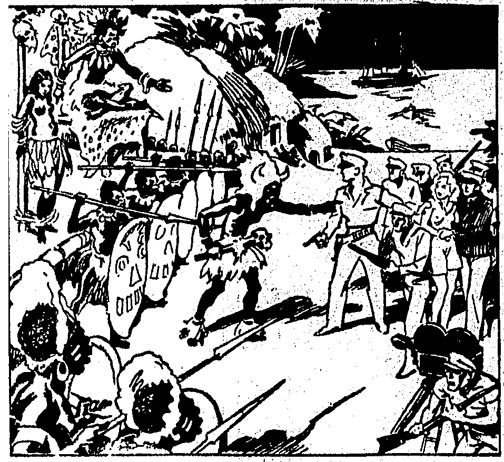
 On Skull Island "King Kong" the great ape who lives atop skull Mountain and of whom every living creature  lives in terror, awaits the sacrifice of a brown girl from the natives. Against him the natives, have erected a tremendous wall. It is on-the ceremonial day when the adventuring producer, Carl Denham, lands with his motion picture troupe.


"A white and gold bride for King Kong! " The natives offer six of their dusky belles in exchange for Ann Darrow, golden blonde leading lady of the picture company. Jack Driscoll, in love.with Ann, is for violence, but Denham and Capt. Englehorn realize they must keep the good will of  the natives. Vowing friendship and promising to return tomorrow, they go back to their good ship, the Adventurer.


Alone - on deck, that night Ann is seized and abducted by the natives. She is not allowed to scream. As they roughly put her over the ship's side to the dougput, she is afraid in a way that she has never imagined.


"Another bride for King Kong!" The natives open the huge defensive gates and place her outside on an altar.  They gather on the ramparts and strike the great gong, signal to "King Kong." Treetops tremble and fall.  "King.Kong is coming!" Then Ann sees leering down at her on her high altar — an ape fifty feet tall!  Helpless, she screams!

Related Posts Plugin for WordPress, Blogger...